European Parliament Backs Delay to Methane Obligations on Energy Imports
The European Parliament backed a three-year delay to EU Methane Regulation obligations for energy importers. It is a negotiating position, not law in force.
IMPACT SNAPSHOT
- Who is affected
- Worldwide
In this article
Parliament votes for a longer delay
On October 22, 2026, the European Parliament backed pushing back core obligations in the EU Methane Regulation, Regulation (EU) 2024/1787, by three years. The proposed delay covers companies that bring oil, gas and coal into the bloc and, for methane-intensity reporting, EU producers. According to Parliament’s press release, MEPs adopted the position by 341 votes to 225, with six abstentions.
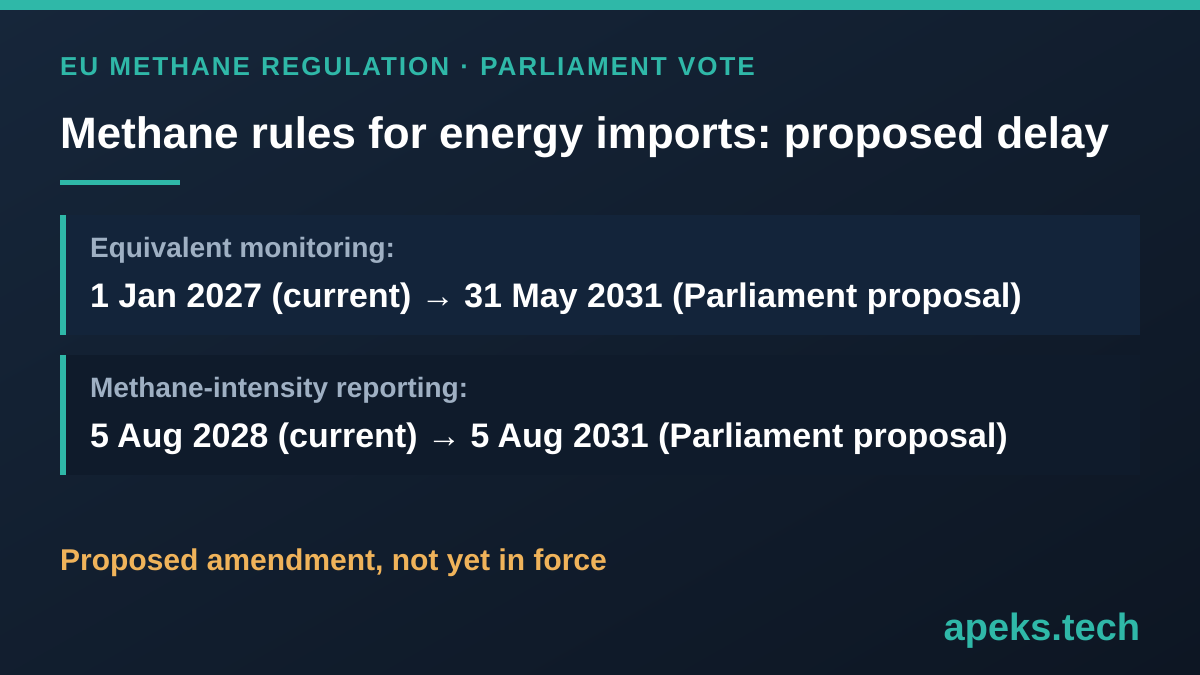
The vote is on a proposed amendment, not on law in force. The European Commission’s proposal was narrower: a one-year postponement of the importers’ equivalent-monitoring obligation, which under the current regulation applies from January 1, 2027, and of methane-intensity reporting, currently due by August 5, 2028. Parliament wants three years instead.
New timelines
Equivalent monitoring: importers must show that the contracts behind their supplies meet monitoring standards equivalent to the EU’s. Under the current regulation this applies from January 1, 2027; the Commission proposed May 31, 2029; Parliament’s position would move it to May 31, 2031.
Methane-intensity reporting would move from August 5, 2028 under the current regulation (August 5, 2029 in the Commission’s proposal) to August 5, 2031.
Reasons cited
Importers have argued that compliant supplies may be hard to secure while energy markets stay tight and prices remain high because of the Middle East conflict.
Sanctions carve-out
Imports from countries under EU sanctions that restrict or ban this trade would be excluded from the extension.
What comes next
Parliament can now open negotiations with the Council of the European Union on the changes. The vote fixes Parliament’s position, not the final law. Until an amending regulation is agreed and published, the January 1, 2027 date in the current regulation still applies.
Why it matters for shipping
The obligations fall on EU importers and producers, not on ships; shipping meets them indirectly, through the supply contracts behind crude, LNG and coal cargoes bound for the EU. Ships’ own methane slip falls under EU MRV, the ETS and FuelEU Maritime.
- European Parliament, Legislative Observatory: 2026/0325(COD) Reduction of methane emissions in the energy sector: postponement of certain obligations
- Regulation (EU) 2024/1787 on the reduction of methane emissions in the energy sector (EUR-Lex)
- COM(2026) 569 final, proposal amending Regulation (EU) 2024/1787, 2026/0325(COD)
- European Parliament press release (EuropaWire copy, 23 October 2026): European Parliament proposes three-year extension of EU methane compliance deadlines for energy importers
- Ship & Bunker: European Parliament Postpones EU Methane Regulation Requirements
Spot an error? Request a correction
Apeks Tech Editorial Team
Sourced curation
The Apeks Tech editorial team — sourced briefs and engineering-led curation; sources are listed on every brief. Editorial policy →
Forward this to a colleague
Should your DPA, technical superintendent or a fellow owner see this? Forwarding costs nothing.
Was this forwarded to you? Take your own copy → subscribe here.