EU ETS for ships of 400 to 5,000 GT: what the Commission proposed, which ships, which dates
On 17 July 2026 the European Commission proposed bringing smaller tankers, gas and LNG carriers, general cargo ships and offshore vessels of 400 to 5,000 GT into the EU ETS from 2031, and extending EU emissions monitoring to tankers, gas carriers and passenger ships from 2029. All dates are proposals.
IMPACT SNAPSHOT
- Who is affected
- TankerGeneral CargoOther
In this article
On 17 July 2026, the European Commission proposed extending EU emissions monitoring from 2029 to six ship categories between 400 and 5,000 gross tonnage. It also proposed bringing four of those categories, plus general cargo ships and offshore vessels in the same size band, into the EU Emissions Trading System from 2031. The European Parliament and the Council must agree before the proposals become law, and the dates may change. Public feedback closes on 3 November 2026 at 23:59 Brussels time.
The EU ETS covers cargo and passenger ships of 5,000 GT and above. Under current rules, offshore ships of 5,000 GT and above join on 1 January 2027. The proposal would extend allowance-surrender obligations below 5,000 GT. The Commission said ships of 400 to 5,000 GT account for “about 15 %” of emissions from ships within the scope of the ETS Directive and that many vessels produce those emissions (COM(2026) 616, recital 24).
Which ships, under which proposal
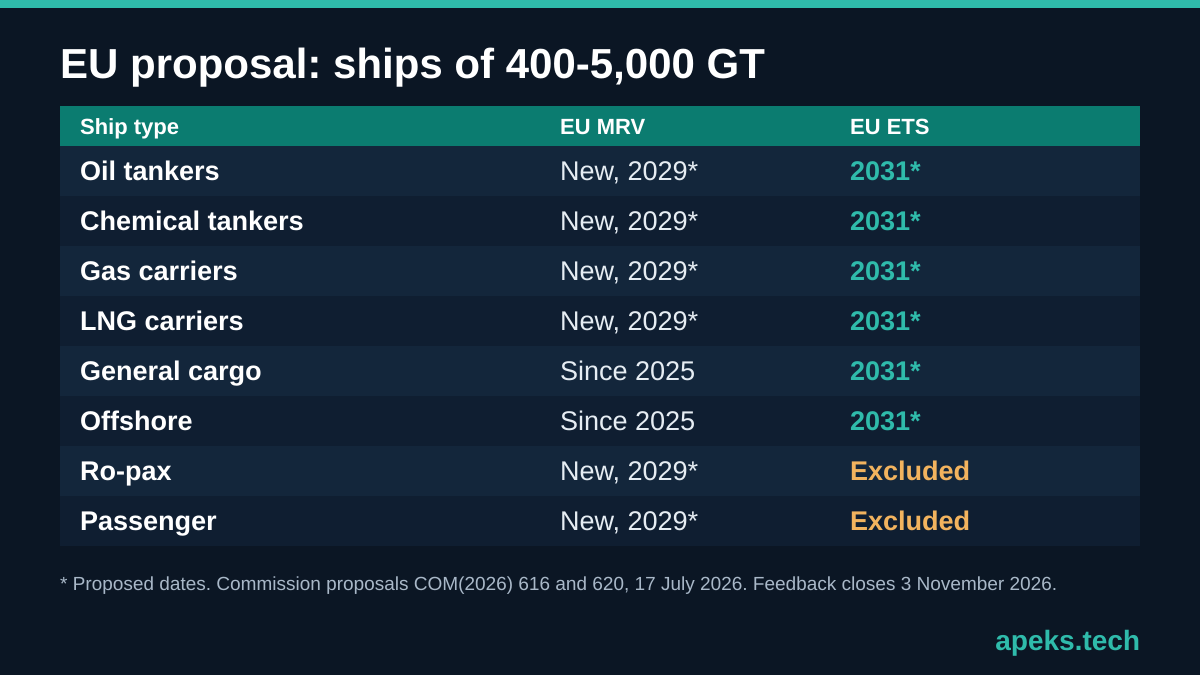
Ships of 400 to 5,000 GT. MRV: COM(2026) 620; ETS: COM(2026) 616. All dates are proposals.
| Ship type | MRV | ETS |
|---|---|---|
| Oil tankers | New, 2029 (proposed) | 1 Jan 2031 (proposed) |
| Chemical tankers | New, 2029 (proposed) | 1 Jan 2031 (proposed) |
| Gas carriers | New, 2029 (proposed) | 1 Jan 2031 (proposed) |
| LNG carriers | New, 2029 (proposed) | 1 Jan 2031 (proposed) |
| General cargo ships | In MRV since 2025 | 1 Jan 2031 (proposed) |
| Offshore ships (support/operations at EU worksites) | In MRV since 2025 | 1 Jan 2031 (proposed) |
| Ro-pax ships | New, 2029 (proposed) | Excluded; report by 31 Dec 2031 |
| Passenger ships | New, 2029 (proposed) | Excluded; report by 31 Dec 2031 |
The draft MRV amendment adds Article 2(1d), which lists the six categories, and moves ships performing or supporting offshore operations at EU Member State worksites, already covered by MRV since 2025 as offshore ships, to a new Article 2(1aa). Recital 12 says they “should be included” in the MRV Regulation “from 2029”. The operative article still shows the application date as a bracketed placeholder, so 2029 states the Commission’s intention rather than a fixed date.
The draft requires companies to submit a verifier-assessed monitoring plan for each ship in scope by 1 April 2029. The administering authority would approve it by 31 December 2029, under draft Article 6(6) and 6(8) of Regulation 2015/757. A ship entering scope for the first time after 1 January 2029 would need to submit its plan no later than two months after its first call at a Member State port, under draft Article 6(7). The final application date will determine which deadline applies to the new categories.
The proposed Annex I to the ETS Directive excludes maritime activities by the new tanker and gas categories, general cargo ships of 400 to 5,000 GT, and offshore vessels from the ETS “until 31 December 2030”. The proposal would therefore bring them into the ETS from 1 January 2031.
Ro-pax and passenger ships would report under MRV but remain outside the ETS. The Commission would need to report by 31 December 2031 on the feasibility and the economic, environmental and social impacts of including them, under proposed Article 3gg(5).
The MRV proposal would also merge paperwork: each ship would have one monitoring plan and one report covering greenhouse-gas emissions and energy used, serving the EU ETS and, where the ship falls within its scope, FuelEU Maritime (COM(2026) 620, recital 6). The proposal does not lower the FuelEU threshold. FuelEU Maritime (Regulation (EU) 2023/1805, Article 2(1)) would still apply only to cargo and passenger ships above 5,000 GT, so ships of 400 to 5,000 GT would take on MRV and, for most categories, ETS duties, but no FuelEU obligations.
For the operator
Who should read this: Owners, managers and DOC holders of small tankers, gas and LNG carriers, general cargo ships, and offshore support vessels between 400 and 5,000 GT that call at EU ports or work at offshore sites in Member State waters. Ro-pax and passenger operators in that size band would face monitoring obligations only.
What changes first: If the proposal passes as drafted and applies from 1 January 2029, the new tanker, gas and passenger categories would first need a verifier-assessed monitoring plan by 1 April 2029. A later application date would trigger the two-month deadline after a first Member State port call. The proposal sets no allowance cost before the 2031 ETS start.
Decisions on the table now:
- Check the band. List ships between 400 and 5,000 GT and identify their category. Tanker and gas categories would face their first EU emissions-reporting duty. General cargo and offshore ships in the band already report under MRV.
- Decide whether to comment. The Have Your Say window closes on 3 November 2026 at 23:59 Brussels time. Feedback requires an EU Login account or a social-media account. Operators who expect a disproportionate burden on very small ships or specific trades can raise it before Parliament and Council negotiations begin.
- Plan the data. A 2029 monitoring plan would rely on voyage-level fuel-consumption, distance and port-call records. Operators need voyage-level records because the EU rules cover emissions from voyages to, from and between EU ports, and at berth in them.
- Review charter terms for 2031 fixtures. Long time charters signed now may run into 2031. Owners and charterers may need to agree how they will split ETS costs. The owner vs charterer ETS tool helps work through how ETS cost is split between the two.
What remains open: the final dates, because the MRV application date remains a placeholder; changes by Parliament or Council to the ship list; and any later inclusion of ro-pax and passenger ships after the 2031 report. Operators should not treat 2031 as fixed until the amending texts are adopted and published in the Official Journal of the EU.
Background
For how the ETS works today for ships of 5,000 GT and above, see our EU ETS shipping compliance guide. The 2026 extension to methane and nitrous oxide is covered in EU ETS and FuelEU 2026: methane counts, scoping rules bite. For FuelEU, see the FuelEU Maritime compliance strategy and our report on the first FuelEU verification period. To estimate allowance cost on a given voyage, use the EU ETS voyage cost calculator.
Sources: COM(2026) 616 final and its Annexes; COM(2026) 620 final; European Commission Have Your Say, initiative 14549. Dates and scope reflect the proposals published on 17 July 2026 and may change during the legislative process.
- COM(2026) 616 final, proposal amending Directive 2003/87/EC (EU ETS), 2026/0212(COD)
- Annexes to COM(2026) 616 final
- COM(2026) 620 final, proposal amending Regulation (EU) 2015/757 (MRV) and Regulation (EU) 2023/1805 (FuelEU Maritime), 2026/0210(COD)
- Have Your Say: EU ETS for maritime, aviation and stationary installations, and MSR review (initiative 14549)
Spot an error? Request a correction
Apeks Tech Editorial Team
Sourced curation
The Apeks Tech editorial team — sourced briefs and engineering-led curation; sources are listed on every brief. Editorial policy →
Forward this to a colleague
Should your DPA, technical superintendent or a fellow owner see this? Forwarding costs nothing.
Was this forwarded to you? Take your own copy → subscribe here.