Tokyo MoU warns: improper certificate extensions can lead to detention
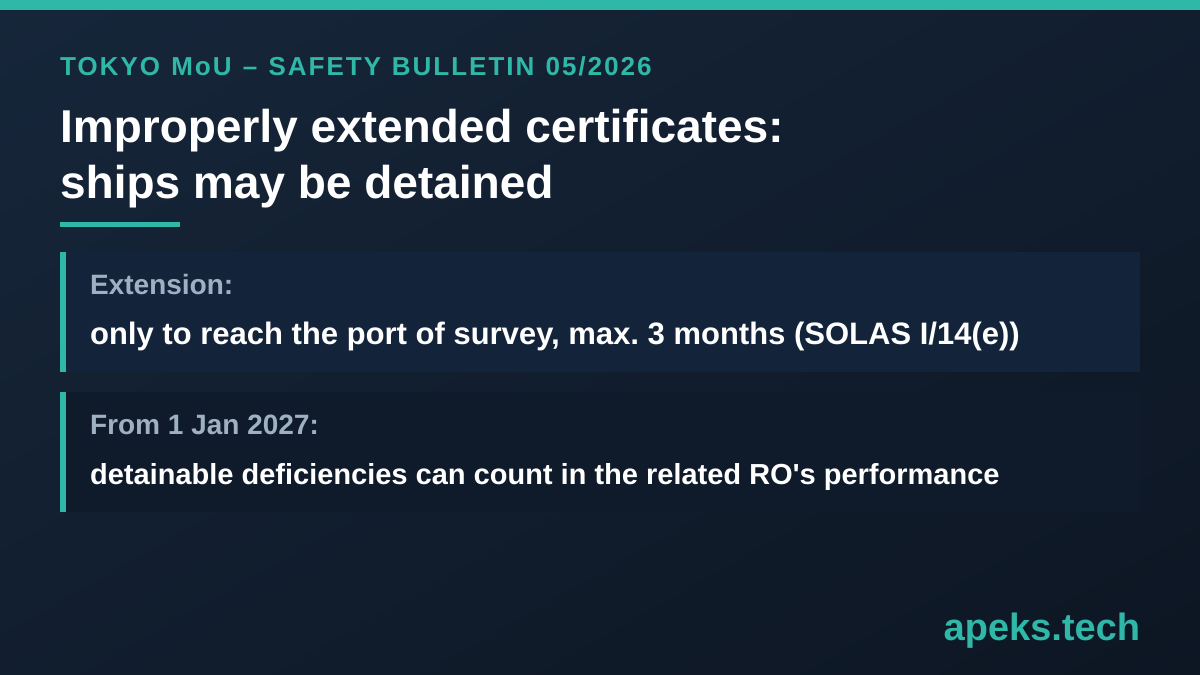
Tokyo MoU Safety Bulletin 05/2026, published 23 October 2026, says ships that keep trading on a SOLAS I/14(e) or (f) certificate extension instead of reaching the port of survey may be detained, and an RO that issued the extension may be held responsible. A separate RO performance method starts collecting data on 1 January 2027.
IMPACT SNAPSHOT
- Who is affected
- TankerDry BulkContainerGeneral CargoPSCFlag/ClassWorldwide
Tokyo MoU’s Safety Bulletin 05/2026, published on its website on 23 October 2026, warns that ships which keep trading under a certificate extended under SOLAS regulation I/14(e) or (f) may face detention at port State control (PSC) inspections in the Asia-Pacific region. An extension in itself is not the problem: the bulletin targets extensions granted contrary to convention or code requirements, or used to continue commercial operations instead of reaching the port of survey. The bulletin says that where a flag State’s appointed recognised organisation (RO) issued the extension, “the RO may be held responsible for such detention.”
PSC inspection findings
According to the bulletin, PSC officers are finding ships with I/14(e) or (f) extensions that continue commercial trading instead of proceeding directly to the port of survey. Some ships hold three-month extensions and trade, or plan to trade, during that period. Their extensions run longer than the minimum needed to complete the survey, and the survey usually requires dry-docking.
The bulletin links the issue to the pandemic: “many ships are only now approaching their first scheduled drydocking cycle since the pandemic.” It adds that reliance on the COVID-19 relaxations in IMO Circular Letter No.4204/Add.19 “have been withdrawn”.
Certificate-extension rules
The convention limits are not new. SOLAS regulation I/14(e) permits an extension only to complete the voyage to the port of survey, for no longer than three months. HSSC paragraph 5.9.1 restates that limit. Under I/14(f), a certificate of a ship on short voyages (neither leg over 1,000 miles; HSSC 5.4) that has not been extended under (e) may instead receive a period of grace of up to one month (HSSC 1.3.6, 1.4.8). IMO circular MSC-MEPC.5/Circ.1 of 26 September 2005 lists eight recommended conditions that Administrations “should be guided by”, including an extension “for the minimum amount of time needed”.
Tokyo MoU sets its own acceptance test. Member Authorities “can only accept an extension if all of the following conditions are met”: a convention or code provision grants it with a “limited time requirement”; it takes the ship to a final cargo discharge port and then directly to the survey port, “but not be used to continue commercial operations”; and “it appears proper and reasonable to do so.” The bulletin states: “An extension is not an additional period of ordinary certificate validity.”
Australia’s AMSA takes the same position in Marine Notice 2026/01, whose page was last updated 28 August 2026. AMSA adds that a detained ship may be allowed to sail under detention to the port of survey.
A separate Tokyo MoU change, not linked to the bulletin, starts with data collection on 1 January 2027. A press release dated 9 October 2026 says Tokyo MoU will calculate RO performance through the “related RO” rather than the “responsible RO”. From that date, for each detainable deficiency at an initial inspection, the PSC officer selects the related statutory certificate from the MoU’s “Background table”. The RO that last issued or endorsed that certificate is the related RO. The first RO figures will use 2027 data only, appear around 1 May 2028, and apply to ship selection under the New Inspection Regime (NIR) from 1 July 2028. The flag performance calculation also changes.
For operators
- Match each statutory certificate expiry with the planned dry-dock and survey dates.
- If an extension cannot be avoided, identify the final discharge port and survey port in the request and seek the minimum period, as HSSC paragraph 5.9.2 sets out.
- Apeks interpretation, not stated by Tokyo MoU: the two documents do not refer to each other. If, from 2027, a detention for an improper extension is linked to the extended certificate and an RO endorsed that extension, it could count in that RO’s new performance figures.
Not yet clear
- Which deficiency code PSC officers will record for an improper extension. The Background table maps each deficiency code to a related statutory certificate, for example deficiency code 01102 to the Cargo Ship Safety Construction Certificate. Neither document addresses extensions.
- The Tokyo MoU Committee agreed in October 2025 “to consider measures to be taken for PSCOs to deal with the matter in a uniform approach.” The bulletin does not set out a uniform PSC procedure.
- SOLAS 1974, consolidated text, Netherlands official treaty database
- Tokyo MoU, Safety Bulletin 05/2026: Improper extensions of Statutory Certification (October 2026)
- Tokyo MoU press release: Changing of the Method of Calculation of the Performance on Flag and RO (9 October 2026)
- Tokyo MoU: Background Table for RO Relation
- AMSA Marine Notice 2026/01: Invalid extensions of Statutory Certification (last updated 28 August 2026)
- Tokyo MoU press release: 36th Port State Control Committee, Hong Kong, China (29 October 2025)
- Tokyo MoU press release: 37th Port State Control Committee, Singapore (18 September 2026)
- IMO MSC-MEPC.5/Circ.1: Recommended conditions for extending the period of validity of a certificate (26 September 2005; copy hosted by Deutsche Flagge)
- IMO Resolution A.1207(34): Survey Guidelines under the Harmonized System of Survey and Certification (HSSC), 2025
Spot an error? Request a correction
Apeks Tech Editorial Team
Sourced curation
The Apeks Tech editorial team — sourced briefs and engineering-led curation; sources are listed on every brief. Editorial policy →
Forward this to a colleague
Should your DPA, technical superintendent or a fellow owner see this? Forwarding costs nothing.
Was this forwarded to you? Take your own copy → subscribe here.