RightShip Inspection: Process, Finding Grades and Validity Periods
A guide to the RightShip inspection process, RISQ finding grades, the 15-day close-out, the validity matrix and the Rev 4.0 vetting criteria.
In this article
- Key Takeaways
- What is a RightShip inspection, and what determines its validity?
- Inspection triggers in Rev 4.0
- Before boarding: booking, documents and officer matrix
- On the day: the inspector’s reference material
- Finding grades and validity periods
- Close-out: 15 days, root cause and peer review
- Events that shorten validity after inspection
- Operator implications
- Checklist: from booking to validity
- Official sources
Key Takeaways
- A RightShip inspection ends with 12, 9, 6 or 3 months of validity, or an Unacceptable record. RightShip says the result rests on three elements: the severity of the findings, the number of findings and the quality of the close-out submission. Two Inspections Superintendents peer-review the close-out before validity is set.
- The operator has 15 days from receiving the findings to submit a close-out for each finding. RightShip considers an extension only where the operator has genuine difficulty meeting the deadline.
- Under Revision 4.0 of RightShip's Dry Bulk Vessel Vetting Baseline Criteria (dated 1 October 2026), a vessel whose most recent RightShip inspection was Unacceptable is Unacceptable (rule 17). A vessel whose most recent inspection resulted in 3 months' validity or less is subject to review and may be Unacceptable (rule 18).
- Booking an inspection does not by itself guarantee a positive vetting outcome. Rule 16 keeps a vessel that needs an inspection Unacceptable until a valid inspection "has been completed and found acceptable", or until RightShip is otherwise satisfied the requirement no longer applies.
- When a vessel moves to a new DOC company with more than 3 months of validity left, RightShip adjusts validity to 3 months from the date of the change. An internal change to another DOC company within the same parent company, with no crew change, no changes to the SMS/PMS and shore management arrangements remaining consistent, leaves validity unchanged. In either case, specific evidence-based concerns may lead RightShip to apply a shorter validity or an immediate inspection.
What is a RightShip inspection, and what determines its validity?
A RightShip inspection is an on-board physical inspection of a dry bulk or general cargo vessel. A RightShip-accredited inspector carries it out against the RightShip Inspection Ship Questionnaire (RISQ). RightShip describes the inspection as “an essential component” of its desktop vetting process.
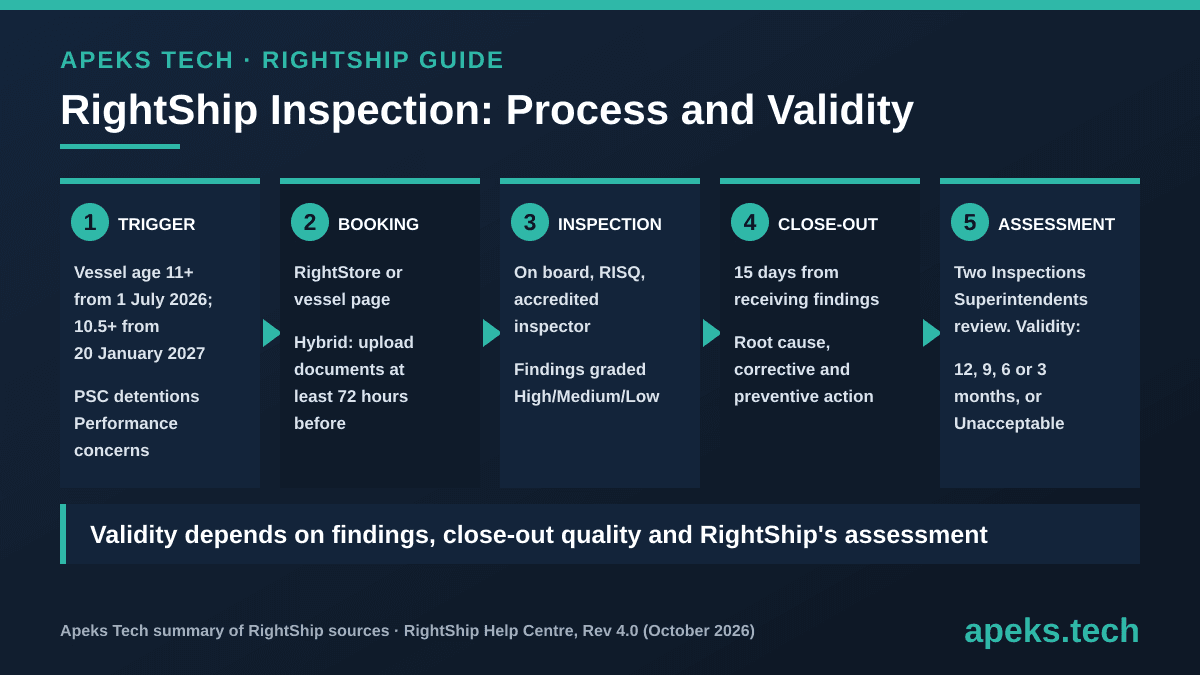
RightShip grades each finding High, Medium or Low. The operator has 15 days from receipt of the findings to submit a close-out for each finding. Two RightShip Inspections Superintendents review the close-out, and the peer review outcome includes an assessment of validity: 12, 9, 6 or 3 months, or Unacceptable. RightShip says the validity matrix rests on three elements: the severity of findings, the number of findings and the quality of the close-out submission.
Revision 4.0 of RightShip’s Dry Bulk Vessel Vetting Baseline Criteria, dated 1 October 2026, now covers general cargo vessels too. Under Rev 4.0, a vessel whose most recent RightShip inspection was Unacceptable is Unacceptable for vetting (rule 17). A vessel whose most recent inspection resulted in 3 months’ validity or less is subject to review and may be Unacceptable (rule 18).
Scope and date. This guide draws on RightShip’s Help Centre and Rev 4.0, read between 24 and 28 October 2026. RightShip says its baseline criteria are recommendations that each vetting customer can customise. This guide does not cover the Safety Score or reproduce RISQ questions. For those, see RightShip requirements and our summary of what changed in Rev 4.0. Where we give advice of our own, we mark it as Apeks Tech guidance, not a RightShip rule.
Inspection triggers in Rev 4.0
Rev 4.0 rules that can lead to a RightShip inspection include (Rev 4.0 criteria; download page):
| Trigger | Rev 4.0 rule | What Rev 4.0 says |
|---|---|---|
| Vessel age: 11 years and above from 1 July 2026; 10.5 years and above from 20 January 2027 | 16 | Without a valid inspection: Unacceptable until one is completed and found acceptable, or RightShip is otherwise satisfied the requirement no longer applies |
| Performance concerns (incidents, PSC inspections, previous RightShip inspections) | 16 | Same as above |
| 3 or more PSC detentions in 24 months | 2 | Unacceptable; an inspection will normally be required before a positive recommendation can be considered |
| 2 PSC detentions in 24 months | 3 | Subject to review and may be Unacceptable; an inspection will normally be required |
| 1 PSC detention in 12 months | 4 | Subject to review; an inspection may be required |
| No PSC inspection records in 24 months | 6 | An acceptable valid RightShip inspection completed within 24 months is normally required. Where none is available, a recent flag State inspection with no adverse reports, or a recent inspection report from a recognised regulatory or industry assurance programme indicating no adverse findings, may be considered; otherwise a RightShip inspection may be required |
| Flag designated by Paris or Tokyo MoU as Targeted, Medium to High or High Risk | 21 | Acceptable only where the vessel has a valid RightShip inspection |
| Category A or B incident in 24 months | 11 | A post-incident inspection will normally be required, depending on incident severity and fault together with close-out quality and any related performance concerns, unless clear and proven non-fault is established |
For the age trigger, Rev 4.0’s summary of conditions that always lead to Unacceptable treats evidence that an inspection “has been completed or is scheduled” as enough to avoid that outcome, but rule 16 itself says the vessel remains Unacceptable “until a valid RightShip Inspection has been completed and found acceptable, or until RightShip is otherwise satisfied that the inspection requirement no longer applies”. A booking alone therefore does not guarantee a positive vetting outcome. Apeks Tech guidance, not a RightShip rule: book early, and do not assume a booking alone keeps the vessel recommendable. To check where a vessel falls, use the RightShip age trigger tool.
Before boarding: booking, documents and officer matrix
- Booking. An inspection can be requested through the RightShip Inspection Booking tab in RightStore or from the vessel page on the RightShip platform. The confirmation email goes to the technical manager named in the request form. On the vessel page, a red badge means the vessel requires an inspection; green means it has a valid inspection; amber means it has had an inspection previously; dark grey means it has no valid inspection.
- Port choice. RightShip lists the countries where it does not carry out inspections and says the list is reviewed periodically. As of 26 October 2026 the list has 21 countries: Algeria, Haiti, Iran, Iraq, Israel, Lebanon, Libya, Mali, Myanmar, Niger, North Korea, Papua New Guinea, Russia, Somalia, Sudan, South Sudan, Syria, Ukraine, Venezuela, Yemen and Saudi Arabia. Check the current list when you book.
- Hybrid inspection. The inspector reviews documents remotely before boarding, then conducts the physical inspection on board. RightShip says all required documents must be uploaded at least 72 hours before the inspection. RightShip sends reminders 72, 48 and 24 hours before the upload deadline. When the upload window closes, the documents are sent to the inspector automatically. Most required documents can be uploaded to the Document Management Centre in advance and reused as long as they remain valid under class or regulatory requirements. Source
- Dual inspection. There is currently no option to request this. If RightShip’s inspections team believes port time is too short for a standard inspection, it may investigate whether two inspectors, splitting the questionnaire between them, are suitable. Source
- Deck and Engineer Officer Matrix. RightShip says the online matrix should reach its dry inspection team and the nominated inspector at least 24 hours before the inspection starts, and that keeping it properly filled out and up to date is the vessel manager’s responsibility. It records rank, certificate of competency, flag endorsement, years with the manager and in rank, months on board and English proficiency.
- Walk the ship first. Most parts of RISQ include a “guide to inspection” that RightShip says assists the ship’s manager in preparing the vessel. Apeks Tech guidance, not a RightShip rule: walk the vessel by area before the inspection. Our RISQ inspection preparation checklist arranges that walk by area without reproducing the questions.
On the day: the inspector’s reference material
RightShip says RISQ goes beyond regulatory requirements to recognised industry practice. It covers statutory items, recommended items and desirable items, with references to IMO, ISO, ILO, OCIMF, ICS, P&I loss prevention bulletins, maritime publications and industry codes of practice. Inspectors use tablets. RISQ places vessels in four categories: bulk carriers carrying solid bulk cargoes other than grain, bulk carriers carrying grain, general cargo ships carrying general and/or container cargoes, and container ships carrying containers. RightShip says an inspection reflects the condition of a vessel and the effectiveness of its management systems at a specific point in time. Attempted bribery of an inspector results in the inspection being recorded as Unacceptable.
Finding grades and validity periods
RightShip grades each finding High, Medium or Low and says the approach aligns with the severity definitions used for PSC deficiencies. High means a clear danger to the vessel or people on board, or an unreasonable threat of harm to the marine environment if not addressed. Medium means no immediate danger but a meaningful weakness in controls, procedures or practices that could increase risk if not addressed. Low means a minor or administrative issue with minimal or no impact on the safety of the vessel, crew or environment. As of 17 June 2026, RightShip removed the automatic impact of “Show-stopper” findings on Safety Scores and inspection outcomes; all findings are now assessed through RightShip’s findings severity methodology and given a Low, Medium or High severity rating. Outcomes and findings of inspections closed before that date remain unchanged and continue to reflect the methodology in place at the time of inspection. Source
Validity is not a simple count of findings. RightShip says the number of findings is assessed in context: “Rather than relying on fixed thresholds, the number of findings is assessed contextually alongside other inspection factors, including the nature, severity, and distribution of findings across RISQ sections.” The quality of the close-out submission is one of the three elements of the matrix, and RightShip says an RCA that clearly addresses the cause and is backed by objective evidence “will positively impact the outcome of the inspection”. RightShip also acknowledges that the assessment of any single finding “will contain an element of subjectivity”, and uses a peer review to limit it. RightShip adds two notes: in Section 3 (Navigation) and Section 13 (Machinery Space), RightShip is currently placing additional emphasis, and one in every four low and/or medium findings may be treated as one high-risk finding; several findings in the same RISQ section may also indicate an SMS weakness in that area.
The validity matrix, as RightShip publishes it (source):
| High-risk findings | Good close-out | Average close-out | Poor close-out |
|---|---|---|---|
| With 23 or fewer low/medium findings | |||
| 0 | 12 months | 12 months | 9 months |
| 1 | 12 months | 9 months | 6 months |
| 2 | 9 months | 6 months | 3 months |
| 3 | 6 months | 3 months | Not explicitly stated in the official matrix |
| 4–6 | 3 months | Not explicitly stated in the official matrix | Not explicitly stated in the official matrix |
| With more than 23 low/medium findings | |||
| 0 | 12 months | 9 months | 6 months |
| 1 | 9 months | 6 months | 3 months |
| 2 | 6 months | 3 months | Unacceptable |
| 3 or more | 3 months (3–6); Unacceptable above 6 | Unacceptable | Unacceptable |
This table is a reading aid, not a tool that calculates outcomes.
Under a good close-out, more than 6 high-risk findings means Unacceptable. Where the table says “Not explicitly stated in the official matrix”, RightShip’s published matrix gives no outcome; this includes 23 or fewer low/medium findings with more than 6 high-risk findings under an average or poor close-out. Apeks Tech guidance, not a RightShip rule: read the matrix as RightShip’s published reference rather than a calculator, and ask RightShip instead of assuming an outcome.
Close-out: 15 days, root cause and peer review
The operator has 15 days from receipt of the findings to submit a close-out for each finding. RightShip says requests to extend this are only considered where an operator has genuine difficulty meeting the deadline. Each submission should explain why the finding was identified, the action taken to correct it and the action taken to prevent recurrence. An Inspections Superintendent independent of the attending inspector reviews the findings, evidence, photographs and root cause analysis, and amends the pre-populated grading when necessary. A second Inspections Superintendent confirms each grade as high, medium or low. The peer review outcome includes an assessment of validity based on the matrix above. Source
Under the heading “Good RCA”, RightShip says it considers a root cause analysis meaningful if it addresses the recorded finding clearly and precisely, uses simple and clear language, identifies cause and effect within the system the operator controls, identifies opportunities to reduce risk, avoids blame, aims at the RISQ criteria and uses a recognised RCA technique. RightShip says a poor RCA is often vague and incomplete, and that this “frequently results in recurring findings”.
Our working split for who should own each close-out (Apeks Tech guidance, not a RightShip rule):
| Finding type | Suggested lead | Evidence to attach |
|---|---|---|
| Equipment or structure | Ship, office for parts and budget | Repair record, dated photographs, class or maker confirmation where relevant |
| Missing or inconsistent record | Office with ship data | The corrected record, reconciled with what the inspector saw |
| Procedure or SMS gap | Office and ship jointly | Revised procedure plus evidence the crew was briefed |
| Repeat of an earlier finding | Office | Why the earlier close-out failed, then the evidence above |
Events that shorten validity after inspection
Change of DOC company. RightShip says a change of DOC holding company transfers responsibility for the vessel’s safety management system to a new organisation, so “an existing inspection may no longer fully represent the vessel under its new management”. Its Help Centre article on management changes sets out two scenarios and their exceptions:
- Scenario 1, change to a new DOC company. At the point of the DOC change, if the vessel has more than 3 months of inspection validity remaining, the validity date will be adjusted to 3 months from the date of the change. If 3 months or less remain, the existing validity date remains unchanged. RightShip says this gives a consistent maximum validity of 3 months after a change of DOC company.
- Scenario 2, internal DOC change. Where the vessel moves to another DOC company within the same parent company, with no crew change, no changes to the SMS/PMS, and shore management arrangements remaining consistent, the existing validity remains unchanged and the expiry date is not adjusted. RightShip says no further action is required unless separate risk concerns are identified.
- Exceptions. RightShip says exceptions to the above may apply where there are specific, evidence-based concerns, including known performance concerns relating to the vessel or the new DOC company; recent incidents, PSC inspection outcomes or inspection findings that require closer oversight; and other material risk indicators identified through standard RightShip processes. In such cases a shorter validity period, or an immediate inspection requirement, may be applied.
- Notification. Where a DOC change is recorded on the RightShip platform and the vessel had more than 3 months of validity remaining, the new DOC holding company receives an automated email confirming the change has been recorded and that validity may be adjusted to 3 months from the date of change.
Separately, Rev 4.0 rules 45 and 46 require a Management of Change (MoC) / Vessel Take Over Process (VTOP) questionnaire to be completed and submitted up to 1 month from the date of a newbuild delivery (rule 45) or a change of DOC company (rule 46), unless the DOC company has a valid RightShip DryBMS Verification Assessment showing at least Advanced Level in DryBMS Subject Area 26, or the vessel has completed an acceptable RightShip inspection. For a DOC change, that inspection must have been completed under the new DOC company. These are two separate mechanisms: the Help Centre’s internal-change exception (same parent company, no crew change, no SMS/PMS change, consistent shore management) only decides whether inspection validity is shortened, while rule 46 is a separate obligation to submit the MoC/VTOP questionnaire after any change of DOC company, with only the two exemptions above. Apeks Tech guidance, not a RightShip rule: unchanged validity after an internal DOC change does not by itself show that the questionnaire is waived; confirm with RightShip. Rev 4.0
Short validity. Rev 4.0 lists “a RightShip Inspection that was awarded only 3 months validity” among the conditions that may lead to Unacceptable. It adds that in most cases an Unacceptable recommendation results from an accumulation of such risk factors rather than one item observed in isolation. Keep the inspection outcome and the vetting recommendation apart. The inspection ends with a validity period or an Unacceptable record; the vetting recommendation is a separate assessment against baseline criteria that each vetting customer can customise. A 3-month validity therefore does not by itself make a vessel Unacceptable. Under rule 18, a vessel whose most recent RightShip inspection resulted in validity of 3 months or less is “subject to review and may be Unacceptable depending on the reason for the limited validity and any other performance indicators”, and a further RightShip inspection may be required. Under rule 17, by contrast, a vessel whose most recent inspection was assessed as Unacceptable is Unacceptable until RightShip is satisfied the findings have been addressed, and a further inspection will normally be required. Rev 4.0
Recurring findings. Rev 4.0’s vetting checks include an assessment of vessel performance based on completed RightShip inspections, beyond the Safety Score, “including the status, severity, recurrence and closure of findings”.
Operator implications
The points below are Apeks Tech guidance drawn from the RightShip sources above, not RightShip rules.
- Close-out quality affects validity. On RightShip’s published matrix, with 23 or fewer low/medium findings and one high-risk finding, a good close-out corresponds to 12 months, an average close-out to 9 months and a poor close-out to 6 months, with the same findings on the vessel. The final grade and validity still come from RightShip’s peer review.
- A DOC company change can shorten validity. If more than 3 months remain, validity is adjusted to 3 months from the change; an internal change within the same parent company leaves it unchanged where the conditions above are met. Plan the MoC/VTOP questionnaire within the 1-month window and, if validity was reduced, schedule the next inspection within the 3 months.
- PSC history feeds the trigger list. Detentions and high-risk PSC deficiencies can lead to an inspection requirement under Rev 4.0 (rules 2–4 and 7). See engine room PSC detentions and the PSC deficiency checklist.
- Navigation and machinery space findings can carry greater weight. RightShip currently says one in four low/medium findings in Sections 3 and 13 may be treated as one high-risk finding. See common engine room inspection risks.
Checklist: from booking to validity
Apeks Tech guidance, not a RightShip rule. The deadlines in the first column come from RightShip; the allocation of tasks is ours.
| When | Who | Action |
|---|---|---|
| On booking | Office | Confirm the port is not on RightShip's current excluded list; name the technical manager and the users who will upload documents |
| By 72 hours before (hybrid) | Office | All required documents uploaded; reuse valid documents already in the Document Management Centre |
| By 24 hours before | Office | Deck and Engineer Officer Matrix sent to RightShip and the nominated inspector |
| Days before | Ship | Walk the vessel by area; check that records match condition |
| Within 15 days of receiving the findings | Office and ship | One close-out per finding: cause, correction, prevention, evidence |
| After the result | Office | Note the validity date; treat 3 months or less as a vetting risk; diarise DOC changes |
For a quarter-long plan, use the RightShip 90-day planner and the RightShip readiness reference. For tanker vetting, see the SIRE 2.0 transition guide.
Official sources
- RightShip — Dry Bulk Vessel Vetting Baseline Criteria, Revision 4.0 (PDF, dated 1 October 2026)
- RightShip Help Centre — Vessel Vetting criteria (download page for the current Rev 4.0, October 2026 criteria)
- RightShip Help Centre — RightShip Inspection Validity Criteria (matrix)
- RightShip Help Centre — Close out process
- RightShip Help Centre — Inspection validity following vessel management changes
- RightShip Help Centre — Hybrid and Dual Inspections
- RightShip — Dry Bulk Vessel Vetting Baseline Criteria, Revision 4.0 (dated 1 October 2026)
- RightShip Help Centre — Vessel Vetting criteria (download page for the current Rev 4.0, October 2026 criteria)
- RightShip — Updates to Vetting Baseline Criteria (note: latest versions take effect from 1 October 2026)
- RightShip Help Centre — Introducing RightShip's Dry Bulk Inspections program
- RightShip Help Centre — RightShip Inspection Ship Questionnaire (RISQ)
- RightShip Help Centre — How to request a RightShip Inspection
- RightShip Help Centre — Hybrid and Dual Inspections
- RightShip Help Centre — Deck and Engineer Officer Matrix
- RightShip Help Centre — Countries where inspections are not undertaken (list as of 26 October 2026)
- RightShip Help Centre — Close out process
- RightShip Help Centre — Root Cause Analysis
- RightShip Help Centre — RightShip Inspection Validity Criteria
- RightShip Help Centre — Inspection validity following vessel management changes
Spot an error? Request a correction
Apeks Tech Editorial Team
Sourced curation
The Apeks Tech editorial team — sourced briefs and engineering-led curation; sources are listed on every brief. Editorial policy →